
The Aesthetic of Good Behaviour
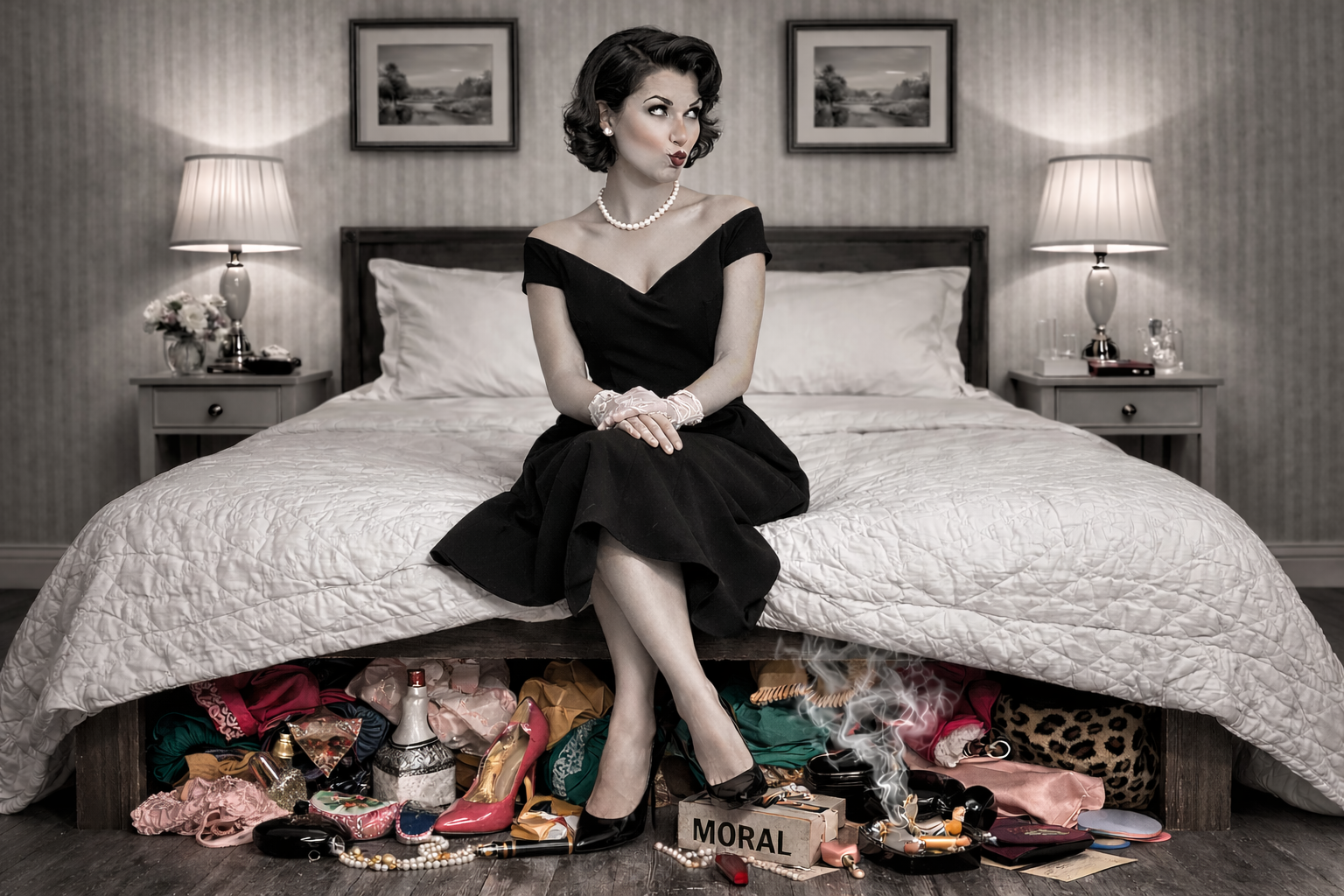
There’s a certain look that gets described as “good taste.”
Clean lines. Nothing too loud. Nothing too much. A bedroom that looks calm, composed, and vaguely well-behaved.
It’s familiar because it’s reassuring – and because it’s been quietly taught.
Good behaviour, it turns out, has an aesthetic.
When Taste Learnt to Behave
Historically, interiors have never just been about comfort. They’ve been about signalling values. Order. Respectability. Self-control. Especially in spaces associated with women, where taste was often expected to reflect morality as much as style.
Bedrooms were no exception. They were meant to be tidy, discreet, and visually restrained – a backdrop for propriety rather than personality. Pleasure, if it appeared at all, was subtle and contained.
Looking “nice” was part of being good.
That legacy hasn’t disappeared. It’s simply been rebranded.
Calm as Compliance
Today’s version of good behaviour wears a softer outfit: magnolia walls, layered neutrals, curated imperfection. It’s marketed as wellness, minimaluxe, quiet luxury. Calm, but make it aspirational.
And calm is lovely – until it becomes compulsory.
When every bedroom starts to look like a place where nothing messy, loud, or unruly could possibly happen, it’s worth asking who that calm is really for. Is it restful? Or is it performative? A visual shorthand for having it all together?
Good behaviour rarely announces itself. It whispers.
The Problem With “Good Taste”
The issue isn’t neutral palettes or minimal spaces. It’s the assumption that taste must always be restrained, polite, and emotionally muted. That self-expression is something to be edited down rather than leaned into.
Perhaps that’s why Tracey Emin’s My Bed caused such uproar when it was exhibited in 1998. The unmade sheets, the detritus on the floor, the evidence of sex, illness, and despair – it wasn’t shocking because it was extreme. It was shocking because it was honest. By placing the private reality of her bedroom in a public gallery, Emin exposed just how uncomfortable we are with what beds actually contain. Critics claimed anyone could have done it. As Emin famously replied: “Well, they didn’t, did they? ”
At Promiscuous Bedding Designs, we’re interested in what happens when you loosen that grip.
When pattern is allowed to ground a room rather than disrupt it.
When leopard print, stripes, or bold graphics function as neutrals – not because they disappear, but because they belong.
When a bedroom reflects how you feel, not how you think you should behave.
Permission Looks Like Personality
Good behaviour is safe.
But safety isn’t the same as comfort.
Comfort comes from recognition – from seeing yourself reflected back in your space. Sometimes that’s soft and whimsical. Sometimes it’s rebellious. Often, it’s both.
A bedroom doesn’t need to look “good.”
It needs to feel honest.
And honesty, unlike good behaviour, has no dress code.